The New Age of Creativity: AI as the “Super-Brush”
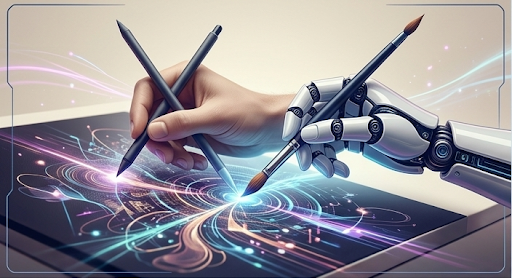
Is a brushstroke more valuable, or the command that moves that brush? AI is not the end of creativity; it is the invention of the “super-brush.” In this article, we examine how tools like Midjourney and DALL-E, rather than leaving artists unemployed, actually give them digital wings. Discover how to unlock the doors to never-before-seen universes when you combine your imagination with a data pool. Remember; technology is just a tool, it is always the human who tells the story.
Throughout history, whenever a new technology takes the stage, the question “Is art dead?” is whispered. When the camera was invented, painters panicked; yet photography did not kill painting—on the contrary, it freed it from the obligation of replicating reality identically, paving the way for revolutionary modern movements like impressionism and cubism. Today, we stand at the exact same threshold with Generative AI.
1. Ending the “Blank Canvas” Fear: Flawless Ideation
The greatest obstacle before an artist or designer is often not a lack of talent, but the “blank canvas paralysis” before making that first brushstroke. Tools like Midjourney or DALL-E are massive brainstorming partners capable of visualizing the abstract concepts in your mind within seconds.
- The Old Way: A concept artist would sketch for days, try out color palettes, and lose valuable time just to establish a single game or movie scene.
- The Next-Gen Way: By testing dozens of different compositions, lighting setups, and styles via AI in minutes, they select the alternative that gives the truest feeling and continue building upon it with their own artistic touch.
AI does not eliminate the artist’s time; it eliminates the heavy lifting.
2. Evolving from “Artist” to “Visual Director”
In the era of generative AI, the artist’s role shifts from a technician moving a brush with millimetric precision to a “Curator or Director” managing the entire scene, lighting, emotion, and actors.
“Writing a prompt is easy; however, finding that exact prompt with the right emotion that tells the right story requires a deep intellectual background.”
Someone who does not know how light should fall on a scene, lacks mastery over the color palettes of Renaissance painters, or fails to understand the dramatic impact of camera lenses might extract a “beautiful” image from AI, but can never create a timeless masterpiece. The artist’s cultural background is the true guide that shapes the brute force of the algorithm.
3. Shattering the Talent Barrier: The Democratization of Art
There are thousands of people who harbor magnificent stories, epic fantasy universes, or deep philosophical metaphors in their minds, but whose hand muscles do not allow them to skillfully wield a brush or pen. AI liberates the imagination by shattering the technical talent barrier.
Telling a story no longer requires graduating with a degree from an academy; having the right words, a powerful vision, and a deep imagination is now enough. This means humanity’s collective pool of creativity expands like never before, making previously unheard stories visible to the world.
Conclusion: The Future of Art Will Be “Hybrid”
AI is an algorithm; it operates on pure mathematical probabilities. It does not have a heart, lived experiences, heartbreaks, or childhood memories. Therefore, every pixel it generates gains meaning through that first “soul” breathed into it by a human—the prompt.
In the art world of the future, those who lose their jobs won’t be artists, but those who view AI as a threat and turn their backs on it. Those who pick up the “super-brush” and merge it with their own imagination will claim the centerpiece in tomorrow’s digital exhibitions.
The Ultimate AI Cockpit on the Boşta Durmasın platform exists precisely for this reason: to turn algorithms into your most creative assistants, not your enemies. Now, head over to the studio, choose your model, and sow the first seeds of that unique universe in your mind!